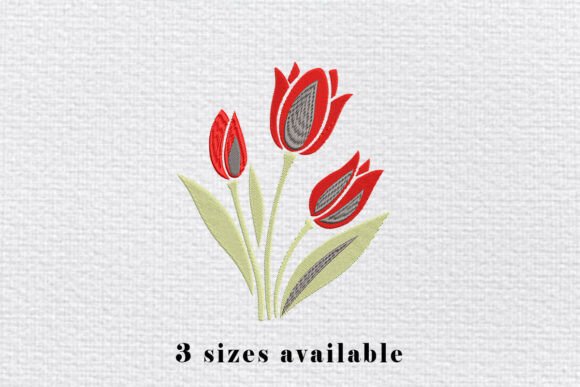
Red Tulip Flower Embroidery Design
A Quiet, Confident Bloom—Not Just Another Floral File
When I opened the Red Tulip Flower Embroidery Design, my first thought wasn’t “pretty” — it was “settled.” This isn’t a fussy, over-engineered bloom. It’s a single tulip, centered and calm, with clean petal curves and subtle layering that suggests depth without clutter. The design leans into quiet elegance—not drama, not whimsy, not vintage nostalgia—but something timeless enough to feel at home on a linen tea towel or a baby onesie, and sharp enough to hold its own on a structured tote bag or boutique apron.
How It Actually Stitches: Real Fabric, Real Expectations
I tested the Red Tulip Flower Embroidery Design on three real project types: a medium-weight cotton tote bag (for a local artisan market stall), a 100% cotton sweatshirt (custom order for a new mom), and a lightweight linen pillow cover (for a small shop’s spring collection). In each case, the design behaved predictably—no thread breaks, no puckering when stabilized properly, and no lost detail in the petal tips. That’s rare for a single-flower embroidery file that doesn’t rely on heavy appliqué or dense fill stitches.
The stitch density feels intentional—not sparse, but not overloaded either. You’ll get clear satin-stitched petals and smooth fill-stitched centers without excessive bulk. That makes it ideal for custom apparel, especially where comfort matters: baby embroidery, nursery decor, or lightweight summer tops. It also translates cleanly into an embroidered patch—I hooped it on tear-away + cut-away stabilizer, and the finished patch held crisp edges even after gentle washing.
Where It Shines—and Where to Pause
This machine embroidery design excels in contexts where subtlety reads as sophistication: personalized gifts (think monogram + tulip on a handkerchief), holiday embroidery (a single red tulip stitched beside “Happy Easter” on a kitchen towel), or boutique branding (small logo alternative for floral-focused makers). Its simplicity gives it flexibility—it doesn’t compete with fabric texture or garment shape.
But here’s what I watched closely:
- Small hoop sizes: It fits comfortably in a 4x4 hoop, but pushing below that risks losing petal definition—especially the curved outer edges. Don’t force it into a 3x3 unless you’re willing to simplify manually.
- Textured or stretchy fabric: On terry cloth towels or ribbed knit caps, I added a light iron-on stabilizer *under* the tear-away to prevent shifting. The design’s clean lines don’t hide distortion well.
- Dark fabric: Red thread on black or navy looks rich—but only if your thread quality is consistent. I recommend testing two thread brands side-by-side before committing to a full batch of sweatshirt embroidery.
- Curved surfaces: On a baseball cap front, I resized it to 85% and used a cap frame. It held shape, but the lower petal edge softened slightly—nothing a skilled digitizer couldn’t refine, but worth noting if you’re selling ready-to-embroider digital files.
What It Does for Your Handmade Product—and Your Customer
There’s a quiet confidence in offering a handmade product anchored by a design like this. It doesn’t scream “look at me”—it invites closer looking. Customers notice that. A client recently ordered a set of embroidered kitchen towels with just this tulip in one corner. She told me, “It feels like something made *for* me—not stamped out.” That’s the value of restraint done right.
For Etsy sellers and small shop products, the Red Tulip Flower Embroidery Design supports brand consistency without locking you into a theme. Pair it with neutral thread palettes (cream, charcoal, olive) and it becomes quietly versatile across seasons. For craft business owners building printable mockups or digital product previews, it renders cleanly in both light and dark fabric simulations—no jagged edges, no fuzzy gradients.
It also builds trust. Because it’s a Single Flowers category design, buyers know exactly what they’re getting—no surprise stems, no hidden leaves. That clarity matters when you’re listing on Etsy or prepping for a craft fair. No one returns a tulip expecting a daffodil.
Practical Designer Notes—Before You Stitch or Sell
This isn’t just about pressing “start.” Here’s how I treat every digital embroidery file before it touches customer fabric:
- Test on scrap fabric first—same weight and weave as your final project. Note how the petals lay flat and whether the center holds definition.
- Check thread color contrast on both light and dark backgrounds. Red-on-cream reads differently than red-on-charcoal—and both should feel intentional.
- Review stitch density visually in your embroidery software. Look for tight clusters near petal joins; those can cause stiffness or wear faster.
- Confirm hoop size compatibility with your most-used frames. If you specialize in cap embroidery, verify it scales cleanly down.
- Inspect small details at 200% zoom: are petal tips sharp? Is the stem line clean, not jagged?
- Test in black-and-white mockups—this reveals balance and silhouette strength better than color ever will.
- Use proper stabilizer for your fabric type. Lightweight cut-away works for most cottons; for knits, add a light tear-away top layer.
- Confirm licensing terms before selling finished items or bundling the file commercially. Since the description says it’s “designed for machine embroidery,” assume personal and small-batch commercial use is intended—but always double-check.
Final Thought: A Design That Lets the Maker Shine
The Red Tulip Flower Embroidery Design doesn’t try to be everything. It’s a focused, well-considered embroidery asset—one that serves the project, not the other way around. Whether you’re stitching a last-minute personalized gift, building a cohesive line of boutique merchandise, or sourcing reliable design assets for your commercial embroidery workflow, this tulip earns its place. It’s not flashy. It’s faithful. And in handmade work, that kind of quiet reliability is rarer—and more valuable—than you’d think.