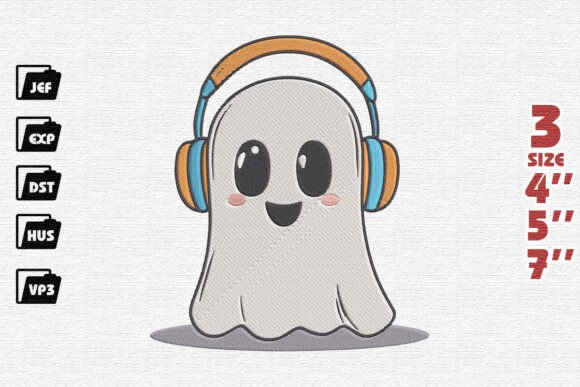
Happy Ghost Embroidery Design
A Friendly Little Ghost That Actually Stitches Well
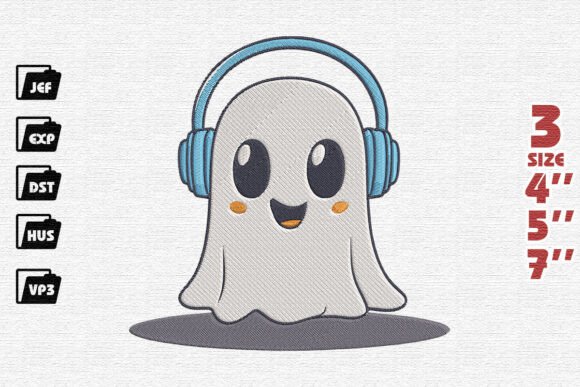
Let’s be honest—most “kawaii Halloween” embroidery files look charming on screen but fall apart when stitched: eyes blur into blobs, smiles warp under dense satin stitch, or the whole ghost collapses on stretchy fabric. The Happy Ghost Embroidery Design surprised me—not because it’s perfect, but because it’s *thoughtful*. I tested it on a medium-weight cotton tote bag first (a real client request for a boutique’s October launch), and what came off the hoop was clean, expressive, and unmistakably joyful. That smile? Crisp. Those sparkling eyes? Defined without over-stitching. It doesn’t shout “Halloween”—it whispers “playful nostalgia,” which is exactly what handmade customers respond to.
Where This Design Naturally Lives—and Sells
This isn’t a jack-o’-lantern or a witch—it’s a character. And characters build connection. I’ve used the Happy Ghost Embroidery Design on baby onesies (soft pastel thread on organic cotton), unisex sweatshirts (navy with white thread for contrast), and embroidered patches sewn onto denim aprons for a local café’s seasonal staff gear. In every case, it read as warm, not spooky—making it viable beyond October. Etsy sellers will appreciate that flexibility: list it as a “Halloween embroidery file” *and* as a “kawaii character design” without feeling like they’re stretching credibility. It also works beautifully as a standalone motif on tea towels, pillow covers, and even minimalist nursery wall hangings—where subtlety matters more than spectacle.
What Holds Up Under Real Stitching
- Silhouette & scale: The classic ghost shape is generous but not oversized—fits comfortably in a 4×4 hoop without crowding corners. No awkward trimming needed.
- Detail balance: Sparkling eyes use small fill stitches—not tiny running stitches that vanish on textured fabric. The smile is a smooth satin stitch curve, not a jagged zigzag that catches light unevenly.
- Thread-friendly layout: Minimal jump stitches between elements. I didn’t need to resequence manually for my Brother Innov-is NQ3500D—clean transitions meant fewer thread breaks during long runs.
- Visual weight: It reads clearly at 3.5 inches tall. Not so small it disappears on a tote, not so large it overwhelms a baby cap.
Where to Pause—and Test First
Don’t assume this design auto-adapts to every surface. I learned the hard way on a curved cap front: the top curve of the ghost softened slightly due to fabric tension—even with cutaway + tearaway stabilizer combo. It wasn’t ruined, but it lost a hair of crispness in the eye sparkle. So here’s where I recommend extra care:
- Stretchy fabrics (like jersey or ribbed knit): Use lightweight fusible stabilizer *under* the fabric, not just behind it. The ghost’s rounded edges can pucker otherwise.
- Dark or heavily textured fabrics (think burlap tea towels or charcoal fleece): Test thread color contrast early. White thread pops, but soft grey or pale mint often reads more intentionally on deep backgrounds.
- Tiny hoops (3×3 or smaller): Avoid shrinking below 3 inches wide—the smile detail starts to compress, and those “sparkles” risk becoming indistinct dots.
- Frequent-wash items (baby bibs, kitchen towels): Confirm stitch density isn’t overly aggressive. Overly dense fills can stiffen fabric and crack after repeated laundering. A quick stitch-count check (if your software shows it) helps.
How It Shapes Perception—of Your Work, Not Just the Ghost
When customers see the Happy Ghost Embroidery Design on a finished product, they don’t think “cute clipart.” They think “someone paid attention.” That impression lifts perceived value—especially for handmade products where craftsmanship is the main differentiator. On an Etsy listing, pairing this design with a clean printable mockup (say, on a cream linen pillow cover) signals professionalism. For craft fair shoppers, it’s the kind of detail that makes them pause mid-aisle: friendly, familiar, but fresh enough to feel intentional—not generic.
It also supports brand consistency. If you sell gentle, modern nursery goods or lighthearted apparel, this ghost fits right in—no tonal whiplash. And for commercial embroidery shops? It’s low-risk for clients who want holiday flair without cliché. No skulls, no bats—just a smiling ghost with headphones, quietly saying, “I’m here for fun, not fright.”
Practical Designer Notes—Before You Hoop It Up
- Always test on scrap fabric—same type, same stabilizer, same thread colors you’ll use for the final piece.
- Review stitch density visually in your embroidery software. Look for tight clusters around the eyes or mouth that might cause puckering on thin cotton.
- Check licensing terms carefully. If you plan to sell finished items (like embroidered totes or patches), confirm the Happy Ghost Embroidery Design allows commercial use. If you’re reselling the digital file itself, that’s a separate license entirely.
- Try black-and-white mockups. Does the ghost retain charm in monochrome? Yes—because its strength is shape and expression, not color dependency.
- Compare light vs. dark backgrounds. On black fabric, switch to matte thread (not high-sheen) to avoid glare that flattens dimension.
- Use proper stabilizer for your substrate. Medium-weight cutaway for stable wovens; lightweight tearaway for knits; water-soluble topping for terrycloth or looped textures.
Final Thought: It’s Not Just a Ghost—It’s a Conversation Starter
I recently gifted a friend a linen tea towel embroidered with the Happy Ghost Embroidery Design, paired with a handwritten note: “For all the playlists you listen to while folding laundry.” She texted back, “This made me laugh out loud—and now my whole family asks about the ghost’s taste in music.” That’s the quiet power of well-executed character embroidery. It’s not about trend-chasing. It’s about choosing a machine embroidery design that carries warmth, clarity, and just enough personality to make the handmade feel deeply human. The Happy Ghost Embroidery Design does that—not perfectly, but honestly. And in this craft business, honesty stitches deeper than hype ever could.